
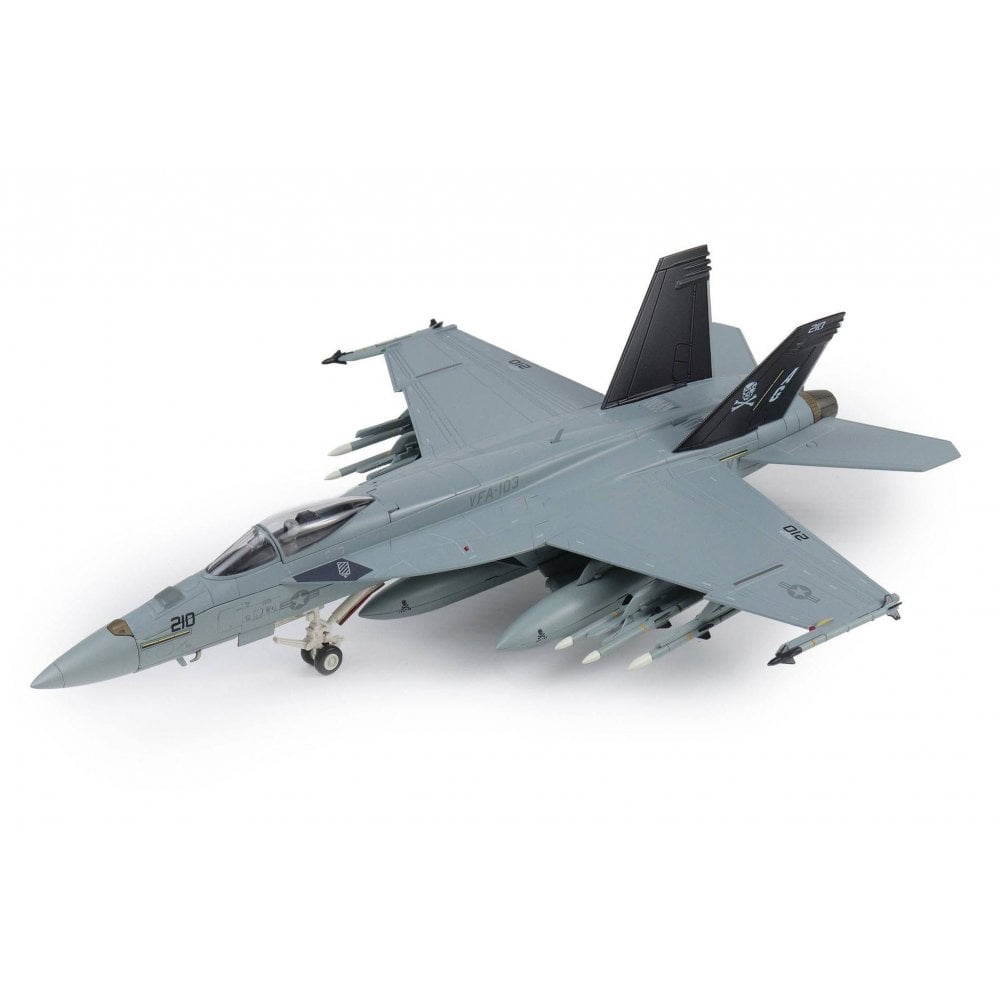
New images added Hobby Master HA5148 F/A-18E Hornet “Jolly Rogers” 166649, VFA-103, US Navy, 2023
US Navy Fighter Squadron 103 (VF-103) was activated in 1952. Three US Navy squadrons have carried the famous Jolly Rogers name and insignia: VF-17/VF-61, VF-84, and VFA-103. While these units are not lineally related, they all shared the Jolly Rogers traditions, including the iconic skull and crossbones markings that remain among the most recognizable in naval aviation. In 2004, the squadron retired its F-14 Tomcats and transitioned to the two-seat F/A-18F Super Hornet. After 19 years operating the “F” model, the squadron added the single-seat F/A-18E Super Hornet in 2023. In a humorous nod to the aircraft’s single-seat configuration, the skull-and-crossbones markings on the tails of the “E” models feature an eye patch, distinguishing them from their two-seat counterparts while preserving the squadron’s legendary pirate heritage.
McDonnell Douglas F/A-18E Super Hornet
Designed as a replacement for the A-4 Skyhawk and the A-7 Corsair II and as a complement to the F-14 Tomcat, the F/A-18 first flew on November 18, 1978. Perhaps best known as the aircraft of the US Navy’s Blue Angels, this carrier-capable, supersonic, all-weather fighter has many roles, including fighter escort, fleet air defence and close air support. The F/A-18 is a versatile aircraft: it can operate from carriers or land bases and a single switch converts it from fighter to strike mode. During Operation Desert Storm, the F/A-18 proved that, on a single mission, one aircraft could serve as both fighter and a bomber.
Comments are closed here.